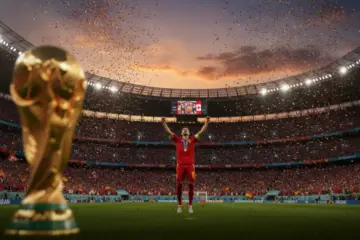

Portugal’s latest World Cup squad announcement carries more than the usual excitement. It brings together a generational icon trying to extend his place in history, a deeply felt tribute to a teammate who is gone too soon, and a roster full of players who believe this group can finally turn talent into a title run.
At the center of it all is Cristiano Ronaldo, who has been selected as he prepares for what could become a sixth FIFA World Cup appearance. Just as important, Roberto Martínez used the announcement to honor Diogo Jota, describing the late forward as Portugal’s “plus one forever.”
Ronaldo Stands on the Edge of Another Milestone
Ronaldo remains the most recognizable name in the squad, and his inclusion gives Portugal both star power and a sense of continuity. At 41, he is still chasing moments that would deepen one of the most decorated international careers in men’s football.
If he appears in the tournament, Ronaldo would join an elite group of players to compete in six World Cups. Lionel Messi could also reach that mark for Argentina, setting up another chapter in their long parallel careers.
What Ronaldo Already Owns
- Most goals scored in men’s international football
- Most appearances in men’s international football
- Only male player to score in five different World Cups
- A leadership role that still shapes Portugal’s identity
Martínez’s decision is not simply about honoring a legend. Ronaldo still offers a competitive edge, a strict standard in training, and the kind of presence that can steady a squad in difficult moments.
A Squad Built to Win in Different Ways
Portugal enters the tournament with a squad that looks both deep and flexible. Martínez has assembled a group that can control possession, attack quickly in transitions, and defend with enough quality to survive against elite opponents.
| Unit | Key Names | Main Strength |
|---|---|---|
| Goalkeepers | Diogo Costa, José Sá, Rui Silva, Ricardo Velho | Reliable depth and coverage in case of injury |
| Defense | Rúben Dias, João Cancelo, Diogo Dalot, Nuno Mendes | Balance of toughness, pace, and attacking support |
| Midfield | Bruno Fernandes, Bernardo Silva, Vitinha, João Neves | Creativity, control, and technical quality |
| Attack | Cristiano Ronaldo, Rafael Leão, João Félix, Gonçalo Ramos | Finishing, pace, and tactical variety |
That mix matters. Portugal is not built around only one style, and that may be one of its greatest advantages. It can dominate the ball with patient buildup, or it can attack directly through wide players and quick combinations around the box.
The Emotional Core: Diogo Jota’s Memory
While Ronaldo drew the headlines, the most emotional part of the squad announcement centered on Diogo Jota. The Liverpool and Portugal forward died in a car crash in Spain last year at the age of 28, leaving a painful void for his teammates and supporters.
Martínez made it clear that Jota will remain part of the team’s story, even if he cannot be on the field. Portugal symbolically named 27 players, treating Jota as the group’s eternal “plus one” despite the official tournament limit of 26.
For Portugal, Jota’s place in the squad is not symbolic in a hollow way. It is a reminder of the bond that football teams can carry long after a player is gone.
That emotional layer could matter more than many outsiders realize. Teams often speak about unity, but Portugal now has a very real source of shared purpose.
How the Attack Could Be Used
Portugal’s front line offers Martínez several workable setups. He can build around Ronaldo as a central reference point, choose Gonçalo Ramos for more movement through the middle, or stretch defenses with speed and one-on-one ability on the wings.
Attack Options at a Glance
- Cristiano Ronaldo for finishing and box presence
- Rafael Leão for pace and direct dribbling
- João Félix for link-up play and creativity
- Gonçalo Ramos for a classic central striking role
- Pedro Neto and Francisco Conceição for width and acceleration
That variety gives Portugal room to adapt from match to match. Against deeper defenses, it can play with patience and precision. Against open teams, it can punish space quickly and force opponents into mistakes.
Group Stage Roadmap and Pre-Tournament Preparation
Portugal has been drawn into Group K, where it will meet Congo, Uzbekistan, and Colombia. On paper, that is a group that still demands focus, but one where Portugal will expect to advance.
The team is scheduled to open against Congo on June 17 in Houston. Preparation begins on June 1, giving Martínez a short but valuable window to sharpen the group before competition starts.
Portugal’s lead-up schedule includes the following:
- Portugal vs. Chile — June 6
- Portugal vs. Nigeria — June 10
- Travel to the United States — June 12
- Portugal vs. Congo — June 17
Those warm-up matches should help Martínez settle selection debates and test different partnerships. With a squad this strong, fine-tuning could decide how far Portugal goes.
Why This Team Has Real Tournament Potential
Portugal has enough quality to be taken seriously by anyone watching the tournament closely. The case for a deep run does not rest on one player alone.
- Elite depth at nearly every position
- Veterans who have already played under pressure
- A midfield capable of controlling tempo and creating chances
- Explosive attacking options that can change a game quickly
- A defense led by the composed and commanding Rúben Dias
- Momentum from winning the 2025 Nations League
- A powerful emotional motive to honor Diogo Jota
That last point should not be overlooked. Emotional motivation does not guarantee success, but it can sharpen focus and deepen commitment when the margin between teams is tiny.
Martínez Balances Belief and Caution
Roberto Martínez has not declared Portugal the favorite, and that restraint feels intentional. He has suggested that the strongest label belongs to nations that have already lifted the World Cup, while still making clear that Portugal can compete with anyone.
The squad’s recent form supports that confidence. Winning the 2025 Nations League by defeating Germany in the semifinal and Spain in the final showed that Portugal can handle pressure against top opposition.
For supporters, that creates a realistic kind of hope. Portugal may not arrive with the weight of a proven world champion, but it does arrive with talent, structure, and belief.
Final Outlook
This World Cup feels significant for Portugal on several levels. Ronaldo is chasing another historic record, Martínez is trying to turn a deep squad into a champion, and Jota’s memory adds a layer of meaning that will stay with the team from the first whistle to the last.
If Portugal finds the right rhythm, it has the tools to threaten anyone in the field. And if this turns into the defining international chapter of Ronaldo’s career, it would also become a story about legacy, unity, and the power of playing for something bigger than yourself.