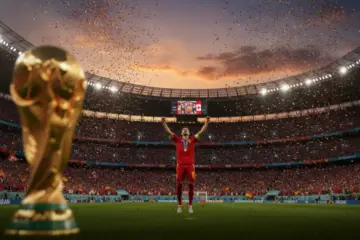

Artificial intelligence has become part of the football conversation, and its latest forecast turns a familiar debate into a futuristic one: which nation is most likely to win the 2026 FIFA World Cup? With Grok, ChatGPT, and Gemini all asked to weigh in, the answers did not match perfectly across every category, but they did converge on one central idea. When the tournament reaches its final stretch, France looks like the team most likely to be standing on top.
That conclusion matters even more because the 2026 edition will be unlike any previous World Cup. The tournament will be spread across the United States, Canada, and Mexico, and the field will expand to 48 teams. More teams means more matches, more travel, more pressure, and more chances for a deep, balanced squad to separate itself from the pack. In that kind of format, raw talent is not enough. Teams also need stamina, discipline, tactical flexibility, and the ability to win ugly when necessary.
Why France Comes Out Ahead
Two of the three AI systems chose France as the eventual champion, and the logic behind that decision is easy to follow. France has spent years proving it can handle the biggest stages in football. It won the 2018 World Cup, reached the final again in 2022, and kept showing the kind of consistency that separates true contenders from one-tournament wonders. By 2026, that experience could be even more valuable, especially in a competition that will ask more of every finalist than before.
The clearest edge for France is depth. A World Cup played under the new expanded format may require teams to survive as many as eight matches if they reach the final. That is a brutal test of fitness and squad management, and France appears built for it. The team has pace, power, technical quality, and players who are comfortable in different tactical systems. If one game calls for a high press and the next demands patience and control, France has the personnel to adapt.
At the center of the French case is Kylian Mbappé, who all three AI systems projected as the tournament’s top scorer. That is hardly a surprise. Mbappé has already delivered on the World Cup stage in a way few players ever have. His eight-goal performance in 2022, capped by his dramatic hat trick in the final against Argentina, reminded the world that he can take over matches when the stakes are highest. In 2026, with more matches available and more chances to build momentum, he may have an even larger scoring window.
France’s title case is not built on Mbappé alone, though. The squad also includes high-level defensive stability and top-class goalkeeping. Gemini singled out Mike Maignan as a candidate for best goalkeeper of the tournament, and that choice reflects how important elite shot-stopping could be in knockout football. A team that can defend well, finish efficiently, and stay calm under pressure is usually dangerous in the final rounds, and France checks all three boxes.
| Category | AI Favorite | Why It Matters |
|---|---|---|
| Champion | France | Depth, experience, and elite match-winners |
| Top scorer | Kylian Mbappé | Explosive finishing and proven World Cup production |
| Best goalkeeper | Mike Maignan | Reflexes, positioning, and big-game reliability |
| Best young player | Lamine Yamal | Creativity, confidence, and one-on-one danger |
Spain, the Smartest Alternative
While France received the strongest overall backing, Spain was not far behind. Grok predicted that Spain would win the title, and the reasoning was rooted in a different kind of strength. If France represents power and depth, Spain represents control. Its case is built on possession, structure, and the ability to make opponents chase the ball for long stretches until mistakes begin to appear.
What makes Spain especially interesting is the way its generation gap seems to be closing in a productive way. The team has younger players who can press aggressively and move quickly through transitions, but it also has enough experience to avoid becoming reckless. In a tournament where one bad defensive moment can end a title dream, that balance is priceless. Spain does not need to overwhelm teams physically if it can control the rhythm and force the game to unfold on its own terms.
The player all three AIs agreed on most strongly was Lamine Yamal, who they selected as the likely best young player of the tournament. By the time the World Cup begins, he will still be a teenager, yet his reputation already suggests a much older player. His close control, vision, and comfort in pressure situations make him one of the most compelling breakout candidates in the entire field. If Spain goes far, he will almost certainly be at the center of the story.
Spain is therefore more than just a spoiler to France’s favorite status. It is a legitimate rival, and if the draw opens the right way, it could become the team that frustrates heavier opponents and wins by precision rather than force.
The Rest of the Field Could Still Rewrite the Script
The AI forecasts did not stop with the top prize. They also pointed toward several nations that could shape the tournament in surprising ways. For the surprise team of the competition, the three systems went in different directions: Grok chose Morocco, ChatGPT picked Japan, and Gemini went with Colombia. Each selection makes sense in its own way. Morocco’s historic semifinal run in 2022 proved it can outlast bigger names. Japan has continued to develop into a disciplined, dangerous side that no longer feels satisfied with being merely competitive. Colombia brings pace, creativity, and players who are entering or approaching their best years.
When the question shifted to the team nobody would want to draw, the answers became even more interesting. Grok picked the Netherlands, pointing to their balance, physical strength, and tournament experience. ChatGPT and Gemini both chose Uruguay, a side that could be especially difficult in a knockout setting under Marcelo Bielsa’s intense system. High pressing, aggressive movement, and relentless energy can turn a match into a grind, and that is exactly the kind of environment where favorites often suffer.
The predicted disappointments were just as revealing. Grok named Brazil, suggesting that even with its usual flood of talent, recent inconsistency could cause problems on a stage that punishes hesitation. ChatGPT and Gemini both selected England, not because England lacks quality, but because expectations will be enormous. When a team enters a World Cup with elite players in every area of the field, anything short of a deep run can feel like failure. That burden can be as heavy as the opposition itself.
There was also one dream matchup that every AI system could agree on: Argentina against Portugal. That would not just be a massive game; it would be the kind of matchup that captures global attention regardless of the scoreline. Lionel Messi and Cristiano Ronaldo could share the World Cup stage one more time, creating a final chapter that many fans have imagined for years. Argentina would arrive as the defending champion, while Portugal would offer a powerful supporting cast featuring Bruno Fernandes, Bernardo Silva, Rafael Leão, and Vitinha. Even before kickoff, the match would feel historic.
What the Forecast Really Means
AI predictions are not guarantees, and football has always been too chaotic to trust any forecast completely. Injuries, draws, weather, momentum shifts, and late-tournament nerves can change everything in a matter of minutes. Still, the pattern in these predictions is informative. France stands out because it combines the traits that usually matter most in a World Cup: elite star power, depth, discipline, and experience in finals-level pressure. That combination is hard to dismiss.
Spain remains the most convincing challenger because of its technical identity and the rising influence of Yamal. Argentina and Portugal could create one of the tournament’s defining storylines. England, Brazil, Uruguay, the Netherlands, Morocco, Japan, and Colombia all have enough quality to reshape the bracket in meaningful ways. But if the question is which team looks best equipped to survive the longest and hardest version of the World Cup ever staged, the answer from the AIs is clear.
France is the team they trust most to finish the job.