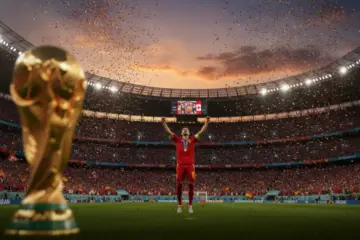

Some tournament records survive for generations because they demand both longevity and precision. Miroslav Klose’s 16 World Cup goals belonged in that category for years, until Lionel Messi matched the mark and turned a once-settlēd race into an active pursuit again.
That matters even more now, with the 2026 World Cup being staged across the United States, Mexico, and Canada. The top of the all-time scoring list is no longer just history; it is a live competition, with Messi tied for first, Kylian Mbappé still rising, and several other legends locked into the chase.
Why This Record Carries So Much Weight
The World Cup is not a normal scoring environment. Players have only a handful of matches per tournament, the pressure is extreme, and a single cold spell can erase an entire campaign. That is why reaching double digits already places a striker in rare company, and why the route to 16 is so difficult.
Unlike league scoring records, this one is shaped by timing, qualification, team quality, and tournament longevity. A player needs elite finishing, multiple deep runs, and often several editions of the competition to have any realistic shot at the top.
The Names At The Very Top
The leading scorers in World Cup history form a short list of attackers from very different eras. Their totals tell a broader story about changing styles, changing schedules, and the challenge of maintaining excellence on the sport’s biggest stage.
- Miroslav Klose – 16 goals for Germany across four World Cups.
- Lionel Messi – 16 goals for Argentina across six World Cups.
- Ronaldo Nazário – 15 goals for Brazil across four World Cups.
- Gerd Müller – 14 goals for West Germany across two World Cups.
- Kylian Mbappé – 14 goals for France across three World Cups.
- Just Fontaine – 13 goals for France in one tournament.
- Pelé – 12 goals for Brazil across four World Cups.
- Sándor Kocsis – 11 goals for Hungary in one tournament.
- Jürgen Klinsmann – 11 goals for Germany across three World Cups.
- Six players tied on 10 – a group that includes Helmut Rahn, Gary Lineker, Gabriel Batistuta, Teófilo Cubillas, Thomas Müller, and Grzegorz Lato.
Klose: The Quiet Standard Setter
Miroslav Klose never needed to dominate headlines to dominate the record book. His value came from repeatable movement, sharp timing, and an uncanny habit of arriving at the exact moment a chance opened up.
He announced himself with a hat trick against Saudi Arabia at the 2002 World Cup, then kept scoring through 2006, 2010, and 2014. By the time Germany lifted the trophy in Brazil, Klose had become the tournament’s most reliable finisher and, for a long time, its unreachable benchmark.
What separates Klose from almost everyone else on the list is efficiency. He needed only 24 matches to reach 16 goals, which remains a remarkable return for a competition where opportunities are so limited.
Messi’s Long Route To The Summit
Lionel Messi’s World Cup story once felt like a contradiction. At club level, he was already one of the most complete scorers the game had ever seen, yet the World Cup record stayed just beyond him for years. The goals came, but not always at the pace his talent suggested they should.
That changed in 2022, when Messi delivered one of the defining tournament performances of the modern era and finally completed the missing piece of his career by winning the trophy. In 2026, he moved alongside Klose at 16, putting his name beside a standard that once looked untouchable.
For Messi, every goal from here adds a new layer to a legacy that had already become complete. Matching the record was a landmark; passing it would create a fresh chapter in World Cup history.
The Chase Behind The Leaders
Ronaldo Nazário’s 15 goals remain a model of explosive brilliance across multiple tournaments. He blended speed, skill, and finishing in a way that made him one of the most feared forwards the event has ever seen.
Gerd Müller’s 14 goals look especially impressive when measured against the small number of games he needed to score them. His instinct inside the penalty area was so sharp that his record still feels modern despite being built half a century ago.
Kylian Mbappé is the most intriguing active threat to the top spot. He already owns a World Cup title, a final hat trick, and one of the highest scoring rates in tournament history. At an age when many all-time greats were only beginning to stack appearances, he is already within striking distance of the summit.
What Makes Mbappé Such A Serious Threat
Mbappé combines speed with ruthless directness, and that combination translates perfectly to knockout football. He can turn one transition into a goal, and he does not need a long sequence of chances to punish a defense.
Just as important, he has time. Many of the names above him built their totals over long careers, but Mbappé has the advantage of entering his prime while still collecting World Cup minutes that could carry him toward the record.
One-Tournament Greatness Still Belongs To Fontaine
If the all-time race is about accumulation, Just Fontaine represents the opposite idea: explosive concentration. His 13 goals in 1958 all came in one tournament, a feat that has never been repeated and may never be matched.
That record matters because it shows how extraordinary a single World Cup can become when everything aligns. Fontaine did not need multiple editions to make history; he produced one of the most astonishing scoring bursts football has ever seen.
The Rest Of The Field Still Matters
The lower tier of the top 10 is packed with players whose totals would be legendary in almost any other context. Pelé’s 12 goals arrived alongside an unmatched mythos, while Sándor Kocsis and Jürgen Klinsmann each built totals that reflected both talent and consistency.
The group tied on 10 goals is also notable because it shows how crowded the upper end becomes once a player crosses the elite threshold. Reaching 10 means entering a very small club; moving beyond it requires sustained excellence and the right tournament conditions.
What To Watch Next
The current standings are not fixed in any meaningful sense. Active players can shift the order quickly, especially if their national teams stay in the tournament deep enough to create extra scoring chances.
That is why the 2026 edition feels different from many recent World Cups. The race at the top has genuine movement, and the gap between first place and third is small enough to change with one hot week.
In practical terms, the story now has three layers: Klose’s enduring standard, Messi’s equalizing surge, and Mbappé’s rapid climb. Each represents a different era, a different scoring path, and a different kind of greatness.