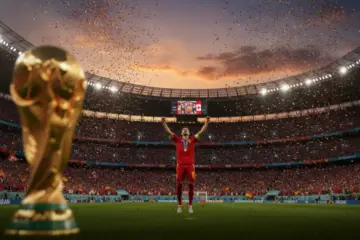

In the pantheon of sports history, there arrives a rare moment when raw statistics transform into pure poetry. Lionel Messi arrived at this transcendent threshold last Monday in Arlington, Texas, compelling the entire world to pause and watch in awe.
At 38 years of age, the Argentine legend achieved something no player, male or female, has ever accomplished before: becoming the outright highest goalscorer in FIFA World Cup history with 18 career tournament goals. He surpassed Germany’s Miroslav Klose (16 goals) and Brazil’s Marta (17 goals) in a single, historic match against Austria.
How the Record-Breaking Run Unfolded
The journey to this record milestone began weeks prior, during Argentina’s opening match against Algeria on June 16. Messi delivered a stunning hat-trick, his first ever at a World Cup, which tied Klose’s long-standing record of 16 goals.
- Oldest Hat-Trick Scorer: At 38 years and 357 days, Messi became the oldest player to score a hat-trick in World Cup history, surpassing Cristiano Ronaldo who was 33 when he achieved the feat in 2018.
- The Austria Match: Six days later against Austria, Messi entered the game with 16 goals. He initially missed a penalty in the ninth minute, but dramatically recovered to score his 17th goal in the 38th minute with a precise left-footed shot.
- Final Touch: In the dying moments of stoppage time, Messi scored his fourth goal of this tournament and his 18th overall, sealing a 2-0 victory and establishing himself as the undisputed top scorer.
Comparing the World Cup Titans
To truly grasp the magnitude of Messi’s achievement, it is essential to compare his record against the previous legends who dominated World Cup scoring charts. The following table highlights the key statistics of the top three scorers in history:
| Player | Nationality | Total Goals | Tournaments Played | Key Achievement |
|---|---|---|---|---|
| Lionel Messi | Argentina | 18 | 6 | First player to score in six consecutive World Cups (men’s & women’s) |
| Marta | Brazil | 17 | 5 | Longest-reigning overall record holder (women’s) |
| Miroslav Klose | Germany | 16 | 4 | Previous men’s record holder for 14 years |
What These Numbers Reveal
Messi’s career longevity is as remarkable as his scoring prowess. His first World Cup goal came on June 16, 2006, against Serbia and Montenegro when he was just 18 years old. Twenty years later, he remains the first player to appear in six different editions of the men’s World Cup.
also, Messi has joined Roger Milla as the only men to score four or more goals in a single tournament while aged 38 or older. Remarkably, 12 of his 18 total World Cup goals have been scored after he turned 35, with 14 of them coming from his left foot.
His teammates have found it difficult to express their admiration. After the victory against Austria, midfielder Alexis Mac Allister stated, “If anyone thought this group was better off without Leo, today it became clear that Leo is the most important of them all”.
The Mbappé Chase: Is the Record Safe?
While Messi currently holds the record, the competition is intense. Kylian Mbappé sits second on the all-time list with 16 career World Cup goals, just two behind Messi.
Mbappé, the French captain, is still actively playing in this tournament. With France performing as genuine contenders, the gap between the two stars could narrow significantly if Mbappé continues his scoring streak. However, for now, Messi stands alone at the summit of World Cup history.
Why This Matters for North American Fans
Beyond the spectacle, there is a critical strategic reason for North American soccer fans to monitor Messi’s form: Argentina is a potential knockout opponent for any team advancing deep into the tournament. The defending world champions have won all their group matches without conceding a single goal, looking like the team to beat.
Understanding the challenge posed by a 38-year-old playing at the peak of his career, surrounded by world-class talent, is not merely interesting—it is essential for any fan anticipating a matchup against Argentina. Watch Argentina’s upcoming matches to see if history is made again, as Messi continues to redefine what is possible in sports.